Reading Alive’s Growth and Heat Signals Before the Round
What Crunchbase and Dealroom can reveal about Alive’s momentum — and what investors should still ask before backing the next phase.

Public company profiles are not a substitute for diligence, but they are useful signals. Crunchbase and Dealroom give investors a way to observe how a young company is positioned, how visible its market activity is, and whether the story is becoming more legible over time. For Alive, the interesting question is not one headline score. It is whether the signals are moving in the same direction as the company’s operating system.
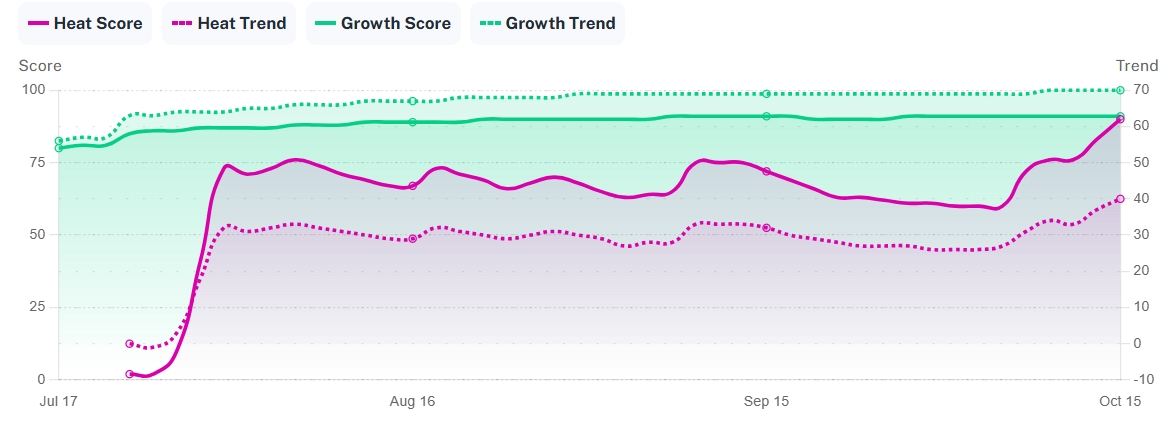
Alive’s current Crunchbase signals
As of 15 October 2026, the Crunchbase view supplied for this article shows a Growth Score of 91, up 11 points in the past quarter, and a Heat Score of 90, up 88 points in the past quarter. The chart also shows the difference between level and momentum: the solid lines indicate the current score levels, while the dotted trend lines show the direction of change. Both measures are strong; the sharp Heat Trend movement is especially notable because it suggests a rapid increase in market attention relative to the prior period.
These are platform signals, not audited financial metrics. Growth Score can help frame how the company is performing relative to historical and comparable signals; Heat Score can indicate that attention, activity or market interest is accelerating. Investors should ask which inputs are observed, estimated or model-derived, and then test the signal against pipeline, conversion, retention, revenue quality and customer references.
What the platform makes visible
- Company momentum: Growth and Heat Scores show changes in growth and market interest relative to historical performance.
- Growth insight: The current growth state and factors contributing to it can guide the next diligence questions.
- News insight: Relevant company news and events can become context for investor research.
- Products, markets and competition: Product positioning, micro-industries, market momentum and ranked competitors help map the commercial landscape.
- Valuation and investors: Current valuation estimates, investment theses and investor matches can help frame a possible round — but none replaces primary diligence.
What a growth score is trying to measure
A growth score is best read as a composite signal rather than a financial result. Depending on the platform and its available data, it can reflect company age, employee movement, web and social visibility, hiring activity, market category, announcements, comparable-company patterns and other observable momentum indicators. It does not prove revenue growth, product-market fit or investor return.
What a heat score adds
A heat score generally asks a shorter-term question: is there unusual attention or activity around this company right now? A rising heat signal may come from hiring, profile views, news, partnerships, founder activity, traffic or market interest. Heat can be valuable because it shows timing, but it is noisy. A company can be hot because people are curious, not because its economics are ready.
The public signals around Alive
Dealroom publicly describes Alive as Berlin-based ESG and AI compliance infrastructure, launched in February 2025, with a 2–10 person team. Alive is fundraising through Swiss investor-relations networks and is currently opening a €3 million round to PE investors, family offices, impact investors and other aligned backers. The business plan, financials and USP are ready; live products and early users are in place, and a B2C and B2B sales motion is in active testing. An EU-funded grant through a Berlin startup programme is also awaiting confirmation. Crunchbase and Dealroom therefore function less like a complete cap table and more like an external visibility layer: they help an investor see how the category, team, company age, funding status and activity are represented in the market.
For an investor, the combination is interesting because the company is early while the operating base is already being built. In its September hydrogen outreach, Alive’s reply rate rose from 9% in the first week to 21% in the second, and booked sales calls went from zero to 20 in two and a half weeks (as of 15 October 2026). These are replies and booked calls, not revenue. Market attention, partnerships, team-building and product activity may therefore be approaching an inflection point; the underlying customer and revenue evidence should be verified in diligence.
The contrast: what Alive is delivering beyond the metrics
Growth and heat metrics describe how a company is being seen. Alive is building what the company can do. Assist turns fragmented documents into evidence, cross-framework analysis and practical readiness actions. Ace connects specific ESG and AI mandates with relevant expert capacity. Alive’s use cases turn that system into repeatable starting points for resilience, reporting, governance, opportunity mapping, implementation and verification.
Leadership is part of the operating system
Alive is also investing in the team behind the products. Through the Leadership Talent Academy (LTA), the founder is sharpening leadership practice, resilience, communication and team-management capability. That matters to investors because early infrastructure companies need more than a strong product idea: they need a leadership system that can make decisions, hire well and preserve accountability as the company grows.
Demand-led outreach: hydrogen and niche markets
The hydrogen market is a useful example of focused outreach. Rather than speaking only to a broad sustainability audience, Alive is exploring niche markets where funded projects, complex supply chains, compliance expectations and specialist capacity create a visible need. Demand-led market work gives the team a way to test whether Assist and Ace solve an urgent problem for a defined group of buyers.
Sharper products, offered every week
Weekly offers and use-case publishing make product learning visible. Each offer creates a focused conversation: a readiness baseline, a document intelligence review, an expert mandate, an implementation brief or a verification preparation path. That rhythm can sharpen Assist and Ace because feedback comes from real problems instead of abstract feature planning.
What investors should ask next
- 1
Which growth and heat inputs are first-party, estimated or platform-derived?
Where we're heading: Every number we share traces back to its source, with platform scores read as timing signals and our own data as the proof.
- 2
What has converted from attention into pilots, paid reports, mandates, partnerships or recurring use?
Where we're heading: Increasing revenue as the proof point, with conversations turning into maps, reports and placements.
- 3
Which niche market is showing the clearest repeatable demand, and what is the buyer’s budget owner?
Where we're heading: Hydrogen is the entry point, and the pattern we are building is funded mandate, market map, matched expert.
- 4
How are Assist outputs reviewed, priced and delivered when regulated customers need traceability?
Where we're heading: Expert-reviewed, source-traceable reports for mid-market companies and AI vendors in regulated markets, delivered the same way every time.
- 5
How does Ace create repeatable expert liquidity without weakening quality, independence or customer accountability?
Where we're heading: Mandates first, with demand from mapping pulling in the right experts and quality checks staying ahead of volume.
- 6
What changed in the product and sales motion after the Leadership Talent Academy, hydrogen outreach and weekly use-case offers?
Where we're heading: Narrower focus, a weekly rhythm and a leadership team built to run it.
Our numbers change daily, so we share them live. Book a call and we’ll walk you through the current picture.
Book a callThe investor takeaway
Crunchbase and Dealroom can make an early company easier to discover and compare. Growth and heat signals can help identify when to look closer. Alive’s case for investment is stronger when those external signals are connected to operating evidence: a clearer leadership system, a focused demand wedge, products that are becoming more useful, and a weekly cadence that turns market learning into execution.
Article references
Sources
- Crunchbase — https://www.crunchbase.com/organization/alive-7199
- Dealroom — https://app.dealroom.co/companies/alive_11
- Alive — https://www.aliveorgs.io/