Inventory
Every AI system you build, buy or embed, with an owner.
AI governance
Most teams arrive here with one of two questions. What does the law ask of us, and how do we run this properly? Start with the one in front of you, and we will connect the rest.
The law
Find your role, classify your systems, plan AI literacy and know what evidence to keep.
Read the EU AI Act guideThe standard
Scope a management system, name owners, set controls and prepare for certification.
Read the ISO 42001 guideNot sure which comes first? Take the maturity assessment and we will point to your next step.
The Act sets what you owe. The standard gives you a way to run it. Both draw on the same owners and evidence, which is why we treat them as one system rather than two programmes.
Every AI system you build, buy or embed, with an owner.
Role, risk class and impact, written down once.
Oversight, data, supplier and change safeguards.
Documents mapped to requirements and traceable to source.
Gaps ranked by what they put at risk.
A steady cadence, so the picture stays current.
Alive structures the system and matches mandates to specialists. Certification and legal opinions stay with independent bodies and advisers.
See what your documents already prove and where the gaps are.
Get your baseline reportDescribe the mandate and interview vetted ESG and AI experts.
Find an ESG and AI specialistOrganise evidence for an internal or independent review.
Prepare for an AI audit reviewThe same owners and evidence can support the wider accountability work shaped by the CSRD and its amendments. Check the current scope on EUR-Lex before relying on any threshold, and see our sustainability reporting use case.
European Parliament and Council · Official source
Use the amended EUR-Lex text for legal wording. Commission Q&A content is implementation guidance only.
European Parliament and Council · Official source
Source for the amended legal wording of Regulation 2024/1689, including Article 4. Quote legal text from here, not from Q&A material predating 27 Jul 2026.
International Organization for Standardization · Standards body
Use for management-system structure and implementation framing, not certification claims.
European Parliament and Council · Official source
Use only for the link between AI governance and sustainability reporting. Do not state thresholds from the 2022 text.
Inside Alive Assist
Each assessment opens as a summary and goes down layer by layer: requirement coverage, gaps with their sources, prioritised actions, a control matrix, a risk register, evidence confidence, exposure scenarios and a board decision pack. Because the structure is identical for every framework, results line up side by side.
NIST AI RMF 1.0
13%
readiness in this sample run
Reflects the evidence supplied, so it rises as gaps are closed.
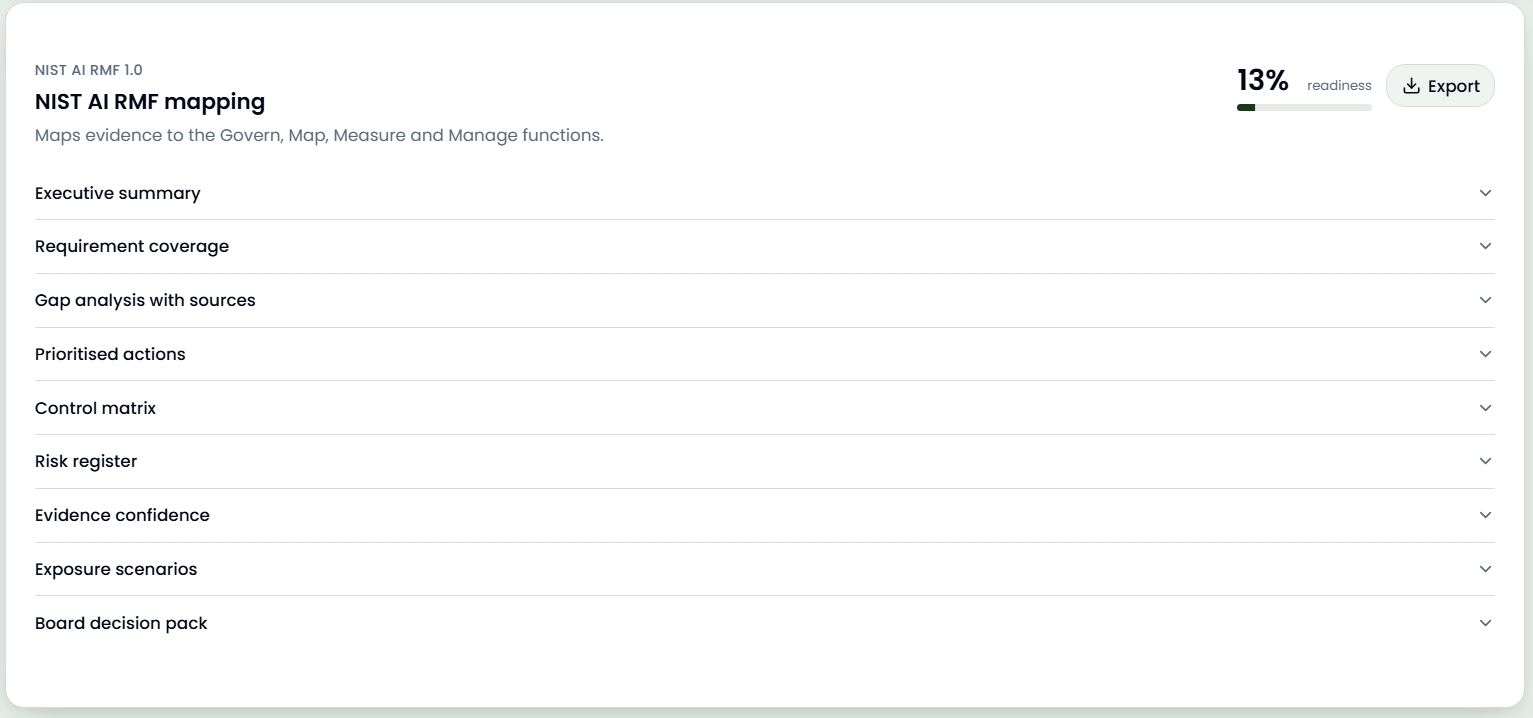
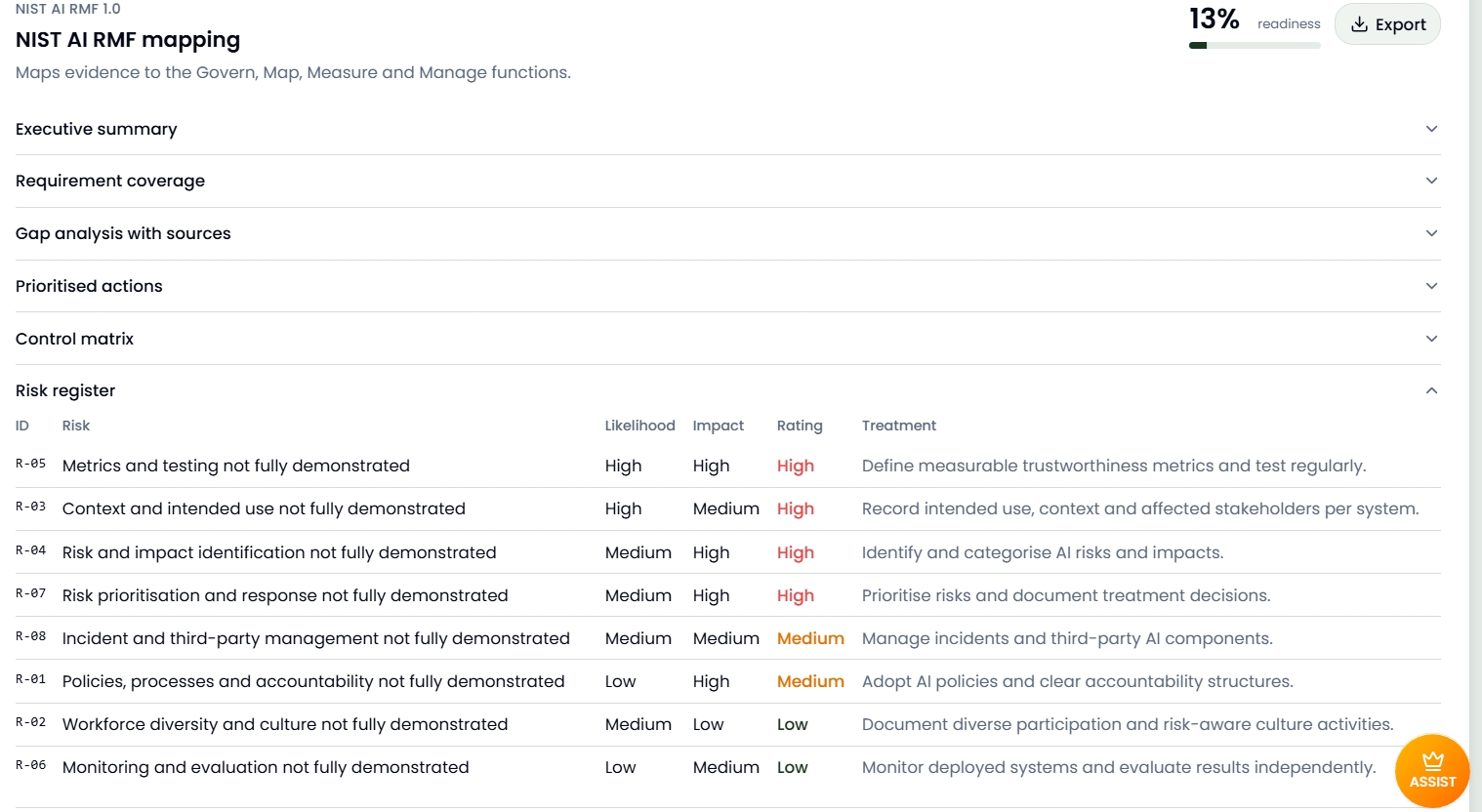
Risk register, layer by layer. Evidence is mapped to the Govern, Map, Measure and Manage functions. The risk register ranks eight gaps, led by metrics and testing, intended use and context, risk identification and risk prioritisation, each with a treatment.
Screens are from Alive Assist sample runs. Readiness reflects the evidence supplied in that run and is not an assessment of any organisation. Alive does not give legal advice or certify compliance.