Scope
Which AI activities, teams and locations does the system cover?
ISO/IEC 42001 guide
The standard gives your organisation a shared way to run AI: who decides, how risk is judged, which controls exist and how you learn from what goes wrong. This guide shows how to build that rhythm, step by step.
Which AI activities, teams and locations does the system cover?
Who sets the policy, provides resources and is accountable?
How do you assess impact, and what happens when something changes?
Which safeguards are designed, tested and kept up to date?
How do incidents and reviews feed back into the system?
Choose one business unit or a handful of AI systems that matter. A narrow, real scope beats a broad, vague one.
Give each system a business owner and a technical owner, and set a regular review with leadership.
Record risks and impacts, then choose proportionate controls for oversight, data, suppliers and change.
Run an internal review, fix what it finds, and widen the scope when the first one is steady.
Certification is carried out by accredited third-party bodies, who will want to see a working system with evidence of operation, not only a set of policies. The usual path is a readiness review, closing the gaps, an internal audit and then the external assessment.
Want to get your evidence in order first? See AI audit readiness.
The operating system
Alive Assist maps your policies, records and reports to the management-system requirements, shows which are covered and which are open, and keeps every finding traceable to its source. Alive Standards give your team a common reference for what good looks like.
Your leadership sets the mandate, and your product, risk, legal and procurement teams supply the evidence. We help with the rest.
A short assessment that shows the next owner, control or piece of evidence to tackle.
Take the assessmentMatch your implementation mandate to a vetted specialist and interview before you decide.
Meet matched specialistsConvert prioritised findings into scoped work with owners and timing.
See implementation supportIt is an international standard for an AI management system. It sets out how an organisation can govern its use and development of AI through scope, leadership, risk, controls, evidence and continual improvement.
No, it is voluntary. Customers, partners and regulators may still value it, because it shows that AI is managed as an ongoing process rather than a one-off project.
No. The standard and the Act are different instruments. A management system can hold the owners, controls and evidence that help you answer the Act, but legal compliance depends on your role and systems.
Accredited third-party certification bodies. Alive supports readiness, gap analysis and implementation, and does not issue certificates.
International Organization for Standardization · Standards body
Use for management-system structure and implementation framing, not certification claims.
Inside Alive Assist
Each assessment opens as a summary and goes down layer by layer: requirement coverage, gaps with their sources, prioritised actions, a control matrix, a risk register, evidence confidence, exposure scenarios and a board decision pack. Because the structure is identical for every framework, results line up side by side.
AI management system
24%
readiness in this sample run
Reflects the evidence supplied, so it rises as gaps are closed.
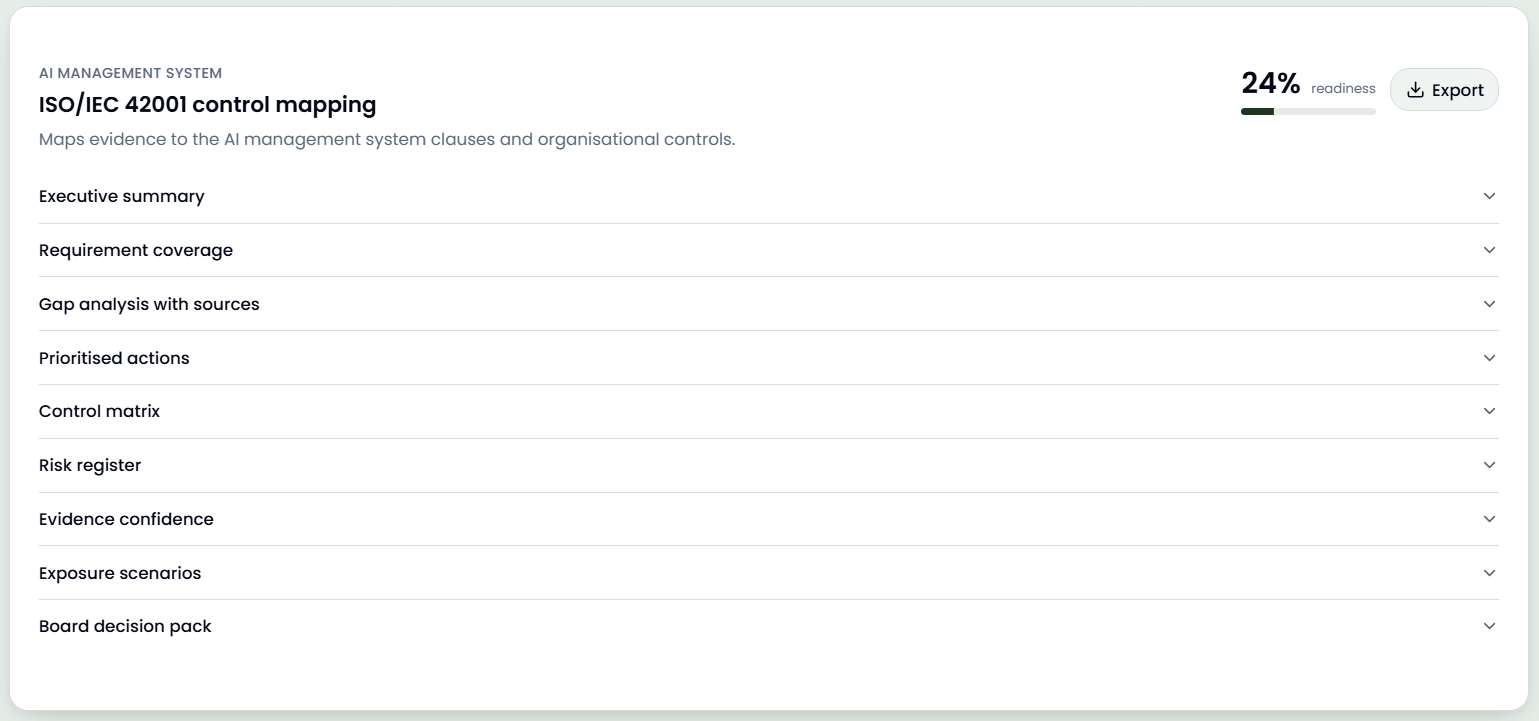
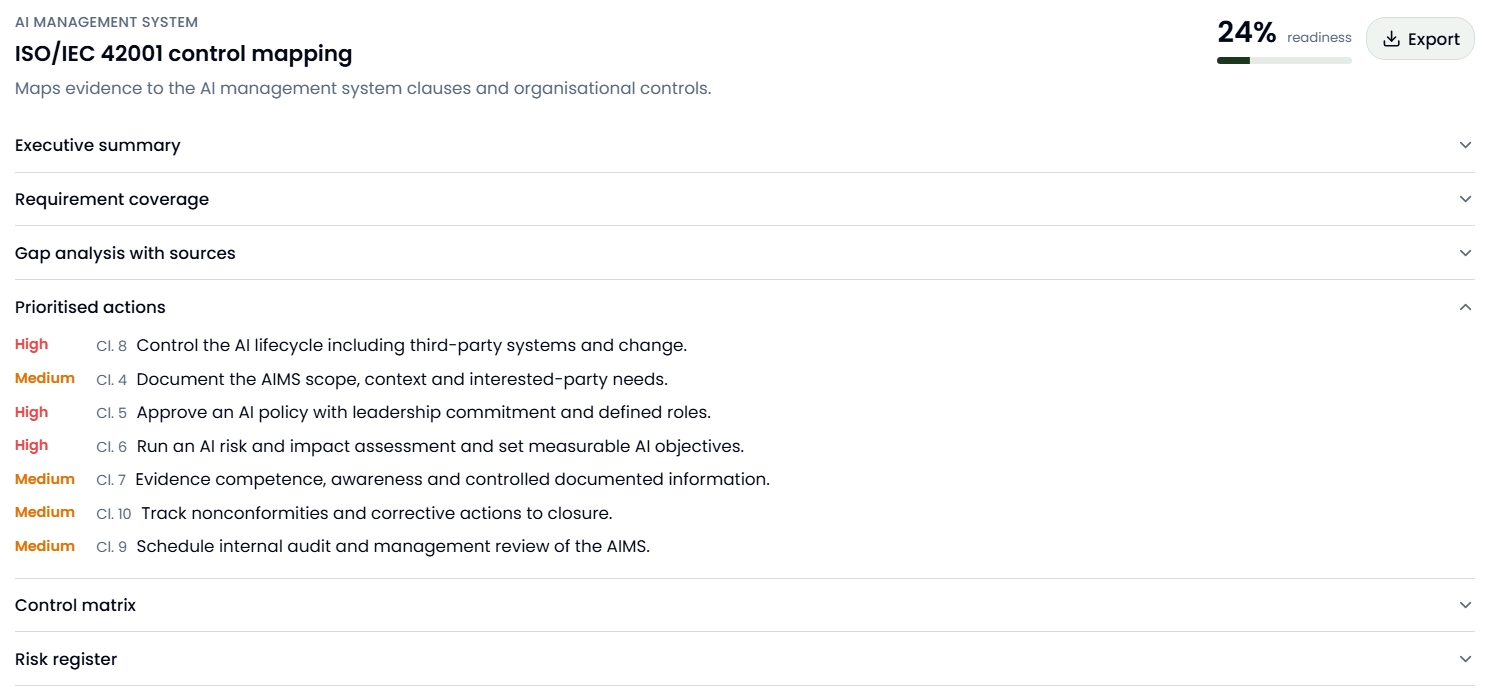
Prioritised actions, layer by layer. Open prioritised actions and the work is ordered by clause: control the AI lifecycle including third parties (Cl. 8), approve an AI policy (Cl. 5) and run an AI risk and impact assessment (Cl. 6) rank High; scope, competence, audit and corrective actions follow.
Screens are from Alive Assist sample runs. Readiness reflects the evidence supplied in that run and is not an assessment of any organisation. Alive does not give legal advice or certify compliance.