Provider
You develop an AI system, or have it developed, and put it on the market under your name.
EU AI Act guide
Whether you build AI, buy it or simply use it at work, the Act asks the same four things of you: who are you in the chain, how risky is the system, what can you show, and who keeps it current. Here is how to answer each one, in order.
One company can hold several roles at once. A software team that builds a model and also uses it internally is both a provider and a deployer.
You develop an AI system, or have it developed, and put it on the market under your name.
You use an AI system in your own work, for example in hiring, credit, support or operations.
You bring a system into the EU market or make it available further down the chain.
You embed AI in a regulated product and place that product on the market.
Practices the Act bans outright. If your use case sits here, the answer is to stop, not to document.
Systems in listed areas such as employment, education, essential services or safety components. These carry the heaviest obligations.
Systems such as chatbots and synthetic media, where people need to know they are dealing with AI.
Foundation models have their own obligations for the providers who release them.
Article 4 asks organisations to make sure the people who work with AI have enough understanding to do it responsibly. Read the exact wording in the amended Regulation on EUR-Lex. The Commission's AI literacy Q&A and its living repository of practices show how other organisations approach it, and are best used as implementation guidance.
For each system that matters, keep these in one place, with a named owner and a review date.
Intended use and risk classification
Data governance and quality checks
Human oversight and escalation steps
Monitoring, incidents and change history
The operating system
Alive Assist reads your existing documents, maps them to the requirements that apply, shows what is present, partial or missing, and turns the gaps into a prioritised action list. It supports readiness. It does not give legal advice or guarantee compliance. Alive helps you prepare through its analyses and expert pool, and is not certified to implement the Act for you. Hands-on implementation is delivered only with selected business partners or experts.
You know your business, and we can help with the rest. Pick the pathway that matches where you are today.
Upload your documents and get a requirement-level view of what is covered and what is open.
Get the readiness reportDescribe the mandate and meet vetted ESG and AI specialists who fit it.
Meet matched specialistsOrganise your evidence for an internal check or an independent assessor.
Prepare for auditIt can. The Act looks at where an AI system is placed on the market or used, and where its output is used, not only where your company is based. Check your role and use cases against the Regulation text, and take legal advice for borderline cases.
On EUR-Lex, in Regulation (EU) 2024/1689 as amended. Commission Q&A pages are helpful for implementation but they do not replace the Regulation, and earlier passages may predate the amendment.
Make an inventory of the AI systems you build, buy or embed, write down who owns each one, and note what it is used for. Role and risk classification both depend on that list.
No. The Act is law, with obligations that depend on role and risk. ISO/IEC 42001 is a voluntary management-system standard that gives you a way to run the work. Many teams use the standard to hold the evidence the Act asks for.
Legal wording comes from EUR-Lex. Commission Q&A material is implementation guidance only.
European Parliament and Council · Official source
Use the amended EUR-Lex text for legal wording. Commission Q&A content is implementation guidance only.
European Parliament and Council · Official source
Source for the amended legal wording of Regulation 2024/1689, including Article 4. Quote legal text from here, not from Q&A material predating 27 Jul 2026.
European Commission · Official source · Updated 2026-07-27
Implementation guidance only. Article 4 legal wording comes from the amended EUR-Lex text.
European Commission · Official source
Inside Alive Assist
Each assessment opens as a summary and goes down layer by layer: requirement coverage, gaps with their sources, prioritised actions, a control matrix, a risk register, evidence confidence, exposure scenarios and a board decision pack. Because the structure is identical for every framework, results line up side by side.
Regulation (EU) 2024/1689
8%
readiness in this sample run
Reflects the evidence supplied, so it rises as gaps are closed.
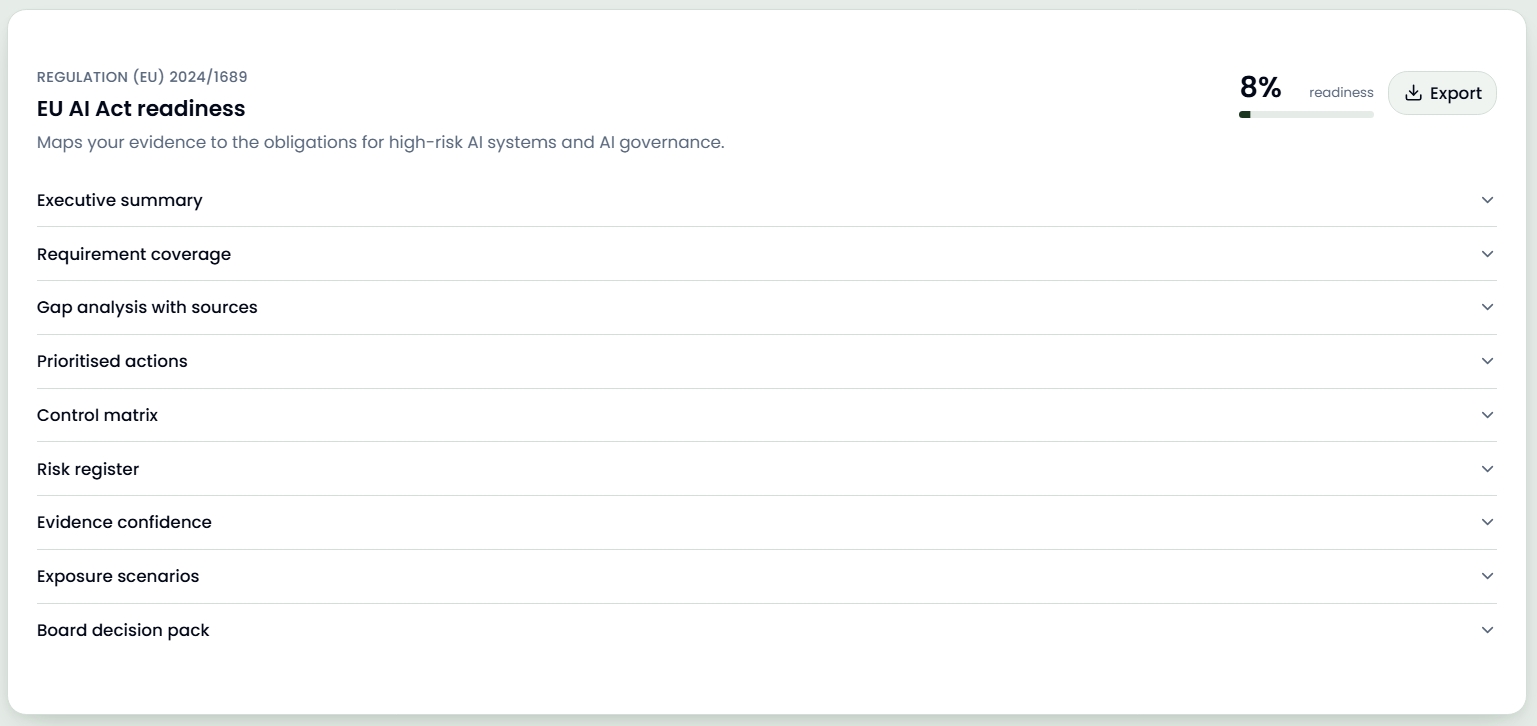
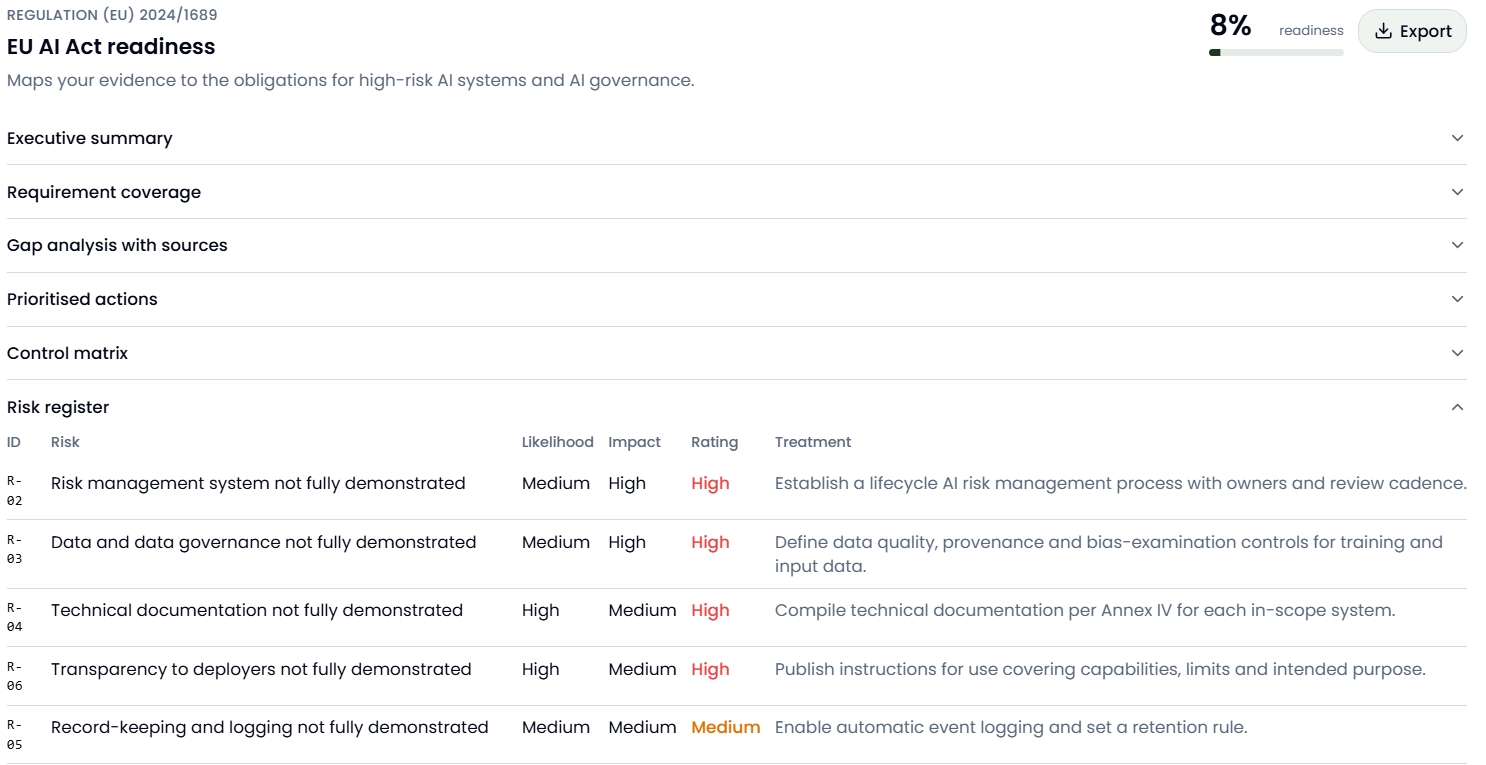
Risk register, layer by layer. Open the risk register and every obligation for high-risk AI systems appears with likelihood, impact, a rating and a treatment: risk management system, data governance, technical documentation per Annex IV, transparency to deployers, and record-keeping.
Screens are from Alive Assist sample runs. Readiness reflects the evidence supplied in that run and is not an assessment of any organisation. Alive does not give legal advice or certify compliance.